

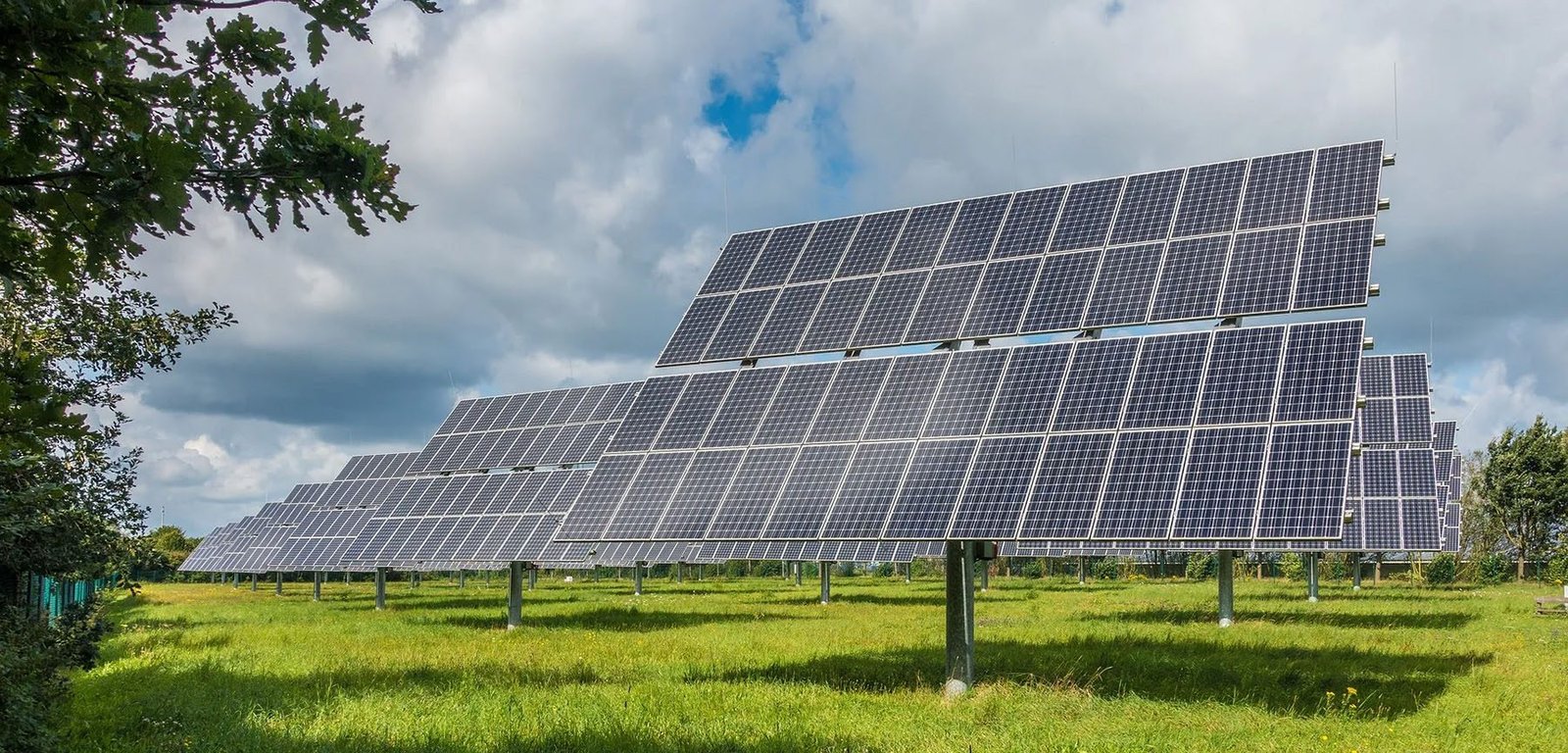
The solar industry, also known as the photovoltaic or PV industry, plays an important role in the global transition toward clean energy. As solar panel manufacturers continue to improve conversion efficiency, product quality, and production stability, the requirements for manufacturing environments are becoming increasingly strict.
Nitrogen is one of the most important industrial gases used in solar cell and solar panel manufacturing. Because nitrogen is an inert gas, it helps protect sensitive materials from oxygen, moisture, and contamination during key production steps.
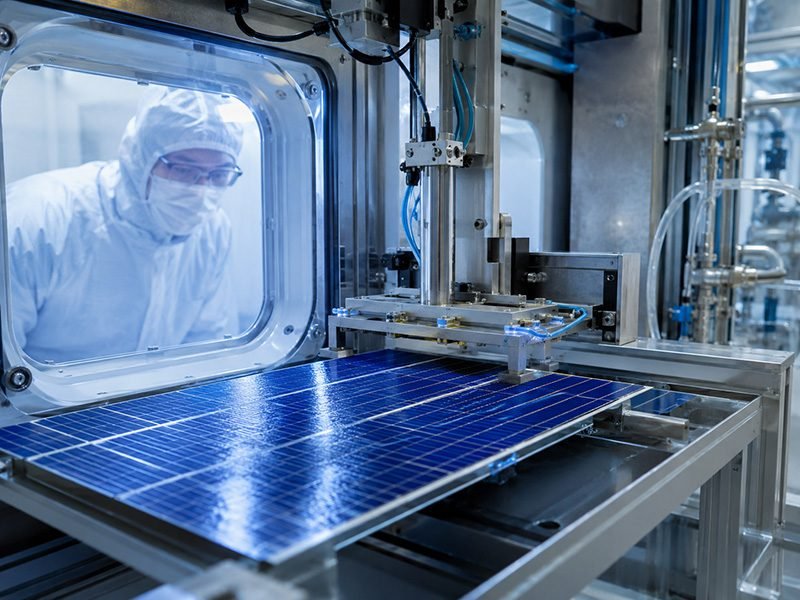
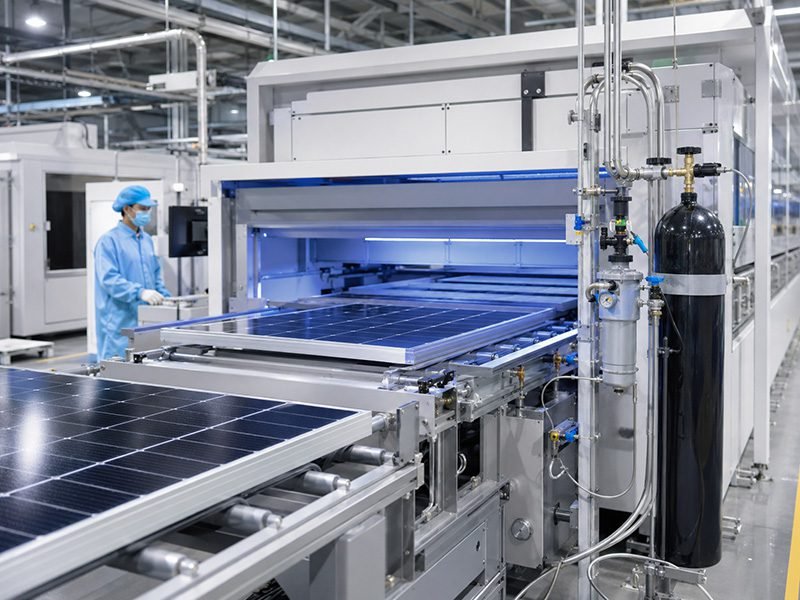
From silicon wafer processing to PV cell production, thin-film coating, diffusion furnaces, lamination, and final packaging, nitrogen helps create a stable and controlled atmosphere for high-quality solar manufacturing.
This article explains the main applications of nitrogen in the solar industry, the benefits of nitrogen protection, and how to choose the right nitrogen generation solution for photovoltaic production plants.
Why Nitrogen Is Important in Solar Manufacturing
Solar cell production involves many materials and processes that are sensitive to oxygen and moisture. Silicon wafers, coating layers, and semiconductor-like structures can be affected by oxidation, surface contamination, and unstable processing conditions.
Nitrogen helps reduce these risks by replacing oxygen-rich air with a dry and inert atmosphere.
In solar manufacturing, nitrogen can help:
Prevent oxidation of silicon wafers
Reduce moisture contamination
Improve coating uniformity
Protect sensitive process environments
Improve product consistency
Reduce production defects
Support continuous automated production
For solar manufacturers, a stable nitrogen supply is not only a gas utility, but also an important part of process quality control.
Key Applications of Nitrogen in the Solar Industry
Nitrogen is used in many stages of photovoltaic manufacturing. Its main function is to create an inert, dry, and clean atmosphere to protect materials and improve production stability.
| Application Area | Nitrogen Role | Main Benefit |
|---|---|---|
| Silicon Wafer Processing | Provides inert protection during cleaning, drying, and handling | Prevents oxidation and surface defects |
| PV Cell Manufacturing | Protects diffusion, doping, and thermal processes | Improves cell performance consistency |
| Thin-Film Coating | Maintains stable atmosphere during deposition and coating | Improves coating uniformity |
| Diffusion and Annealing Furnaces | Provides protective gas atmosphere | Supports stable thermal processing |
| Lamination and Encapsulation | Helps reduce oxygen and moisture before sealing | Improves module durability |
| Storage and Packaging | Provides inert gas protection during storage and transport | Reduces degradation risk |
Nitrogen Supply Methods for Solar Manufacturing
Solar manufacturers usually choose one of three nitrogen supply methods: PSA nitrogen generation, liquid nitrogen supply, or cryogenic air separation.
Each method has different advantages depending on nitrogen consumption, purity requirements, plant size, and operating cost.
| Factor | PSA Nitrogen Generation | Liquid Nitrogen Supply | Cryogenic Air Separation |
|---|---|---|---|
| Supply Method | On-site nitrogen production | Delivered by tanker and stored in tanks | On-site large-scale air separation |
| Typical Scale | Small to medium demand | Small to medium demand | Medium to very large demand |
| Initial Investment | Lower | Lower equipment investment, but requires storage system | Higher |
| Operating Cost | Lower for continuous use | Higher due to logistics and refill cost | Lower at large scale |
| Nitrogen Purity | Up to 99.999% | High purity | Very high purity |
| Supply Stability | Continuous and independent | Dependent on supplier and transportation | Continuous and highly stable |
| Storage Requirement | No large liquid tank required | Requires liquid nitrogen storage tank | Requires large installation space |
| Flexibility | High | Medium | Medium |
| Maintenance | Simple | Low on-site equipment maintenance | More complex |
| Best Application | PV cell plants, module factories, medium-scale production | Backup supply or limited consumption | Large solar manufacturing bases |
There is no fixed boundary between PSA nitrogen generation, liquid nitrogen supply, and cryogenic air separation. The best solution depends on nitrogen consumption, production schedule, purity requirements, plant size, utility cost, and total lifecycle economics.
How to Choose the Right Nitrogen System for a Solar Plant
When selecting a nitrogen system for solar manufacturing, companies should evaluate more than equipment price.
Key factors include:
Required nitrogen flow rate
Required nitrogen purity
Operating hours per day
Peak nitrogen consumption
Electricity cost
Available installation space
Future expansion plan
For many solar manufacturers, PSA nitrogen generation is a practical choice because it provides continuous on-site nitrogen with flexible capacity and lower long-term supply cost. For very large PV manufacturing bases, cryogenic air separation may become more attractive due to large-scale gas demand.
Why Choose Huangshan Deep Gas Co., Ltd.
For the solar industry, we can provide both PSA Nitrogen Generation systems and Cryogenic Air Separation solutions based on customer production scale and project requirements.
Our advantages include:
PSA nitrogen purity up to 99.999%
Capacity range from 10 to 10,000 Nm³/h
Cryogenic air separation solutions for large-scale users
Stable 24/7 industrial operation
Customized engineering design
Remote monitoring and intelligent control
Complete project support from design to commissioning
Instead of recommending only one technology, our engineering team evaluates each project based on nitrogen consumption, purity requirements, operating cost, and future expansion plans. This helps customers choose a reliable and cost-effective nitrogen supply solution for long-term production.