

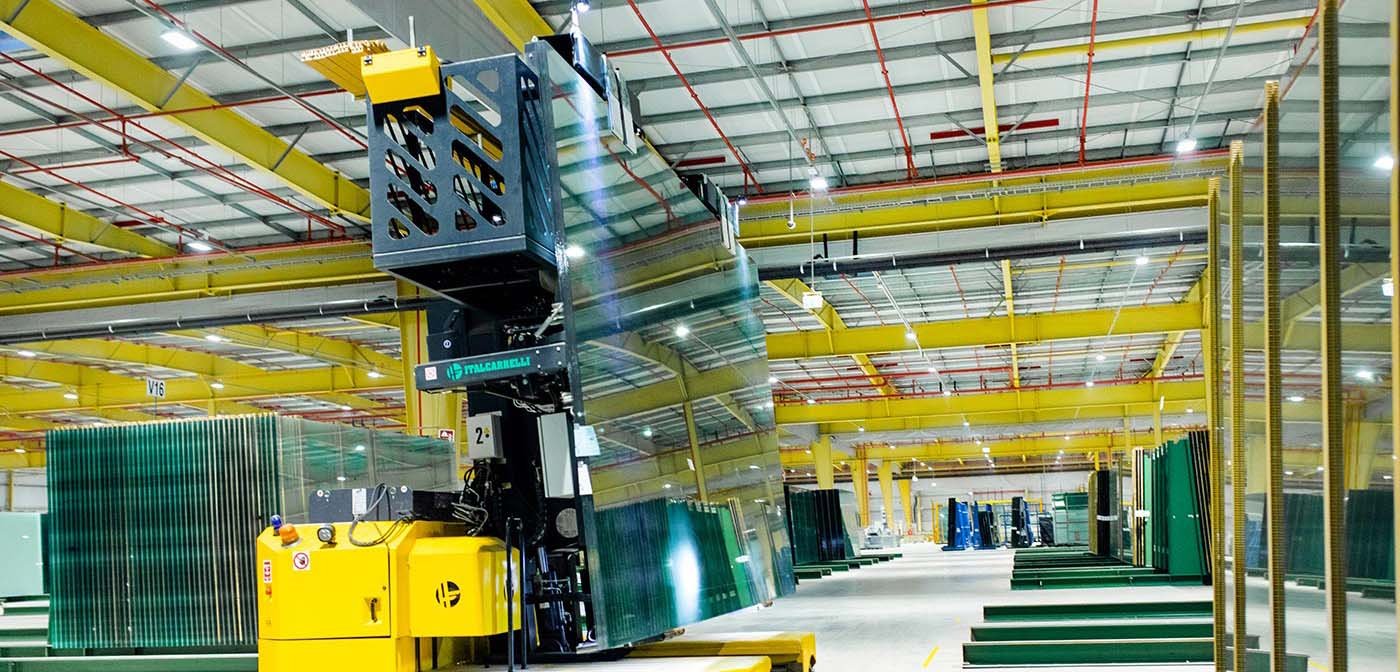
Oxygen and nitrogen play important roles in modern glass manufacturing. From high-temperature glass melting to float glass production, annealing, inert protection, and packaging, industrial gases help improve production efficiency, product quality, and process stability.
As glass manufacturers continue to reduce energy consumption, improve furnace performance, and meet stricter environmental requirements, oxygen-enriched combustion and reliable nitrogen supply have become increasingly important in the glass industry.
Oxygen is mainly used to support combustion, increase furnace temperature, improve melting efficiency, and reduce fuel consumption. Nitrogen is mainly used as an inert gas for protection, purging, atmosphere control, and storage applications.
This article explains the main applications of oxygen and nitrogen in the glass industry, their benefits, and how to choose the right gas generation solution for glass manufacturing plants.
Why Industrial Gases Are Important in Glass Manufacturing
Glass production is a high-temperature and energy-intensive process. Raw materials such as silica sand, soda ash, limestone, and other additives must be melted at very high temperatures before being formed into flat glass, container glass, fiberglass, or specialty glass.
In this process, oxygen and nitrogen help manufacturers improve:
- Furnace efficiency
- Combustion performance
- Melting speed
- Product quality
- Process stability
- Energy consumption
- Emission control
- Inert atmosphere protection
For large glass manufacturers, stable oxygen and nitrogen supply is not only a utility requirement, but also a key part of production efficiency and quality control.
Oxygen Applications in the Glass Industry
Oxygen is widely used in glass furnaces and combustion systems. Compared with air combustion, oxygen-enriched combustion increases flame temperature and reduces the amount of nitrogen introduced into the furnace.
This can improve heat transfer, reduce fuel consumption, and lower exhaust gas volume.
Main Applications of Oxygen in Glass Manufacturing
| Application Area | Oxygen Role | Main Benefit |
|---|---|---|
| Glass Melting Furnace | Supports oxygen-enriched combustion | Higher furnace temperature and faster melting |
| Oxy-Fuel Combustion | Replaces air with oxygen in combustion | Reduced fuel consumption and lower flue gas volume |
| Furnace Boosting | Increases thermal input during peak demand | Higher production capacity |
| Emission Reduction | Reduces nitrogen entering combustion process | Lower NOx formation potential |
| Specialty Glass Production | Provides stable high-temperature process conditions | Better product consistency |
| Fiberglass Production | Supports stable melting and forming processes | Improved energy efficiency and output stability |
Oxygen-Enriched Combustion in Glass Furnaces
One of the most important uses of oxygen in the glass industry is oxygen-enriched combustion.
Traditional combustion uses air, which contains only about 21% oxygen and about 79% nitrogen. Nitrogen does not support combustion and carries heat away through flue gas. By increasing the oxygen concentration in combustion air, glass manufacturers can achieve higher flame temperature and better heat transfer.
This can help glass plants:
- Increase melting efficiency
- Reduce fuel consumption
- Improve furnace productivity
- Reduce exhaust gas volume
- Improve thermal control
- Support lower emission targets
For large glass furnaces, oxygen enrichment can be used as a flexible method to improve production capacity without completely replacing the existing combustion system.
Oxy-Fuel Combustion for Glass Manufacturing
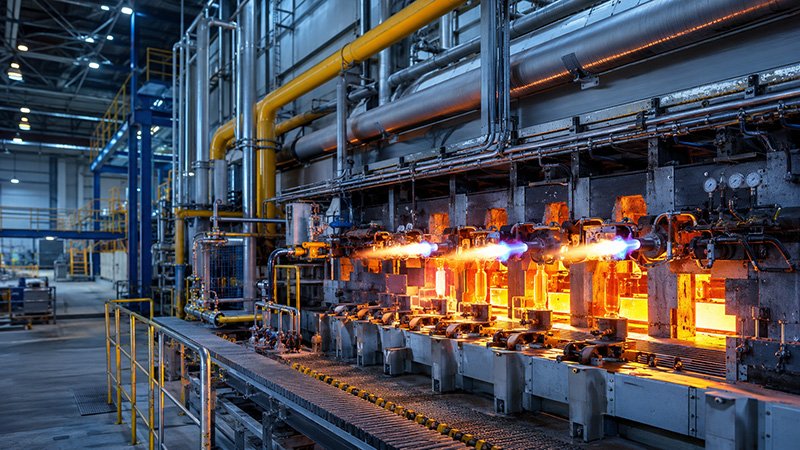
Oxy-fuel combustion uses oxygen instead of air for fuel combustion. This significantly reduces nitrogen in the combustion process and creates a hotter, more efficient flame.
In glass production, oxy-fuel combustion is commonly used when manufacturers need higher thermal efficiency, lower emissions, and better furnace performance.
Compared with air-fuel combustion, oxy-fuel systems can provide:
- Higher flame temperature
- Better heat transfer
- Lower flue gas volume
- Reduced fuel consumption
- Improved furnace atmosphere control
This makes oxygen an important gas for energy-saving and emission-reduction upgrades in modern glass plants.
Nitrogen Applications in the Glass Industry
Nitrogen is an inert gas and is mainly used for atmosphere protection, purging, and process control in glass manufacturing.
Although nitrogen does not support combustion, it is valuable in applications where oxygen and moisture need to be reduced or controlled.
| Application Area | Nitrogen Role | Main Benefit |
| Float Glass Production | Provides protective atmosphere with hydrogen in tin bath | Prevents oxidation and improves glass surface quality |
| Furnace and Pipeline Purging | Removes oxygen and moisture before operation | Improves process safety and stability |
| Specialty Glass Processing | Creates inert atmosphere | Reduces oxidation and contamination |
| Coating and Surface Treatment | Protects sensitive coating environments | Improves coating quality |
| Storage and Packaging | Provides inert protection for sensitive products | Reduces moisture and contamination risk |
| Instrument Gas and Utility Gas | Supports stable plant operation | Improves system reliability |
Nitrogen in Float Glass Production
Float glass production is one of the most important applications of nitrogen in the glass industry.
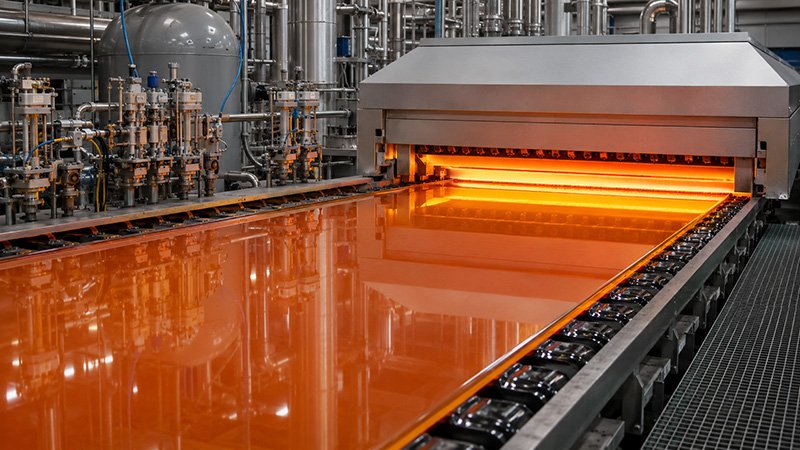
In the float glass process, molten glass floats on a bath of molten tin to form a flat and smooth glass sheet. Because tin can oxidize when exposed to oxygen, the tin bath requires a controlled protective atmosphere.
Nitrogen is commonly used together with a small amount of hydrogen to create a reducing and protective atmosphere inside the tin bath. This helps prevent tin oxidation and supports smooth glass surface quality.
Stable nitrogen supply is essential for:
- Tin bath atmosphere control
- Surface quality improvement
- Oxidation prevention
- Continuous float glass production
- Reduced defect rates
For float glass manufacturers, nitrogen quality and supply stability are critical to long-term production performance.
Nitrogen for Purging and Inert Protection
Nitrogen is also used for purging pipelines, equipment, tanks, and process chambers.
Before starting or shutting down certain systems, nitrogen purging helps remove oxygen, moisture, and unwanted gases. This improves operational safety and protects sensitive process areas.
In specialty glass production, nitrogen can also help protect materials and coatings from oxidation during high-temperature or controlled-atmosphere processes.
Oxygen and Nitrogen Supply Methods for Glass Plants
Glass manufacturers usually choose one or more of the following gas supply methods depending on gas demand, purity requirements, plant size, and operating schedule.
| Factor | PSA Gas Generation | Liquid Gas Supply | Cryogenic Air Separation |
| Supply Method | On-site oxygen or nitrogen production | Delivered liquid oxygen or nitrogen | On-site large-scale air separation |
| Typical Scale | Small to medium demand | Small to medium demand or backup | Medium to very large demand |
| Oxygen Purity | Typically 93%–95% | High purity | High purity |
| Nitrogen Purity | Up to 99.999% | High purity | High purity |
| Initial Investment | Lower | Lower equipment investment, but storage tanks required | Higher |
| Operating Cost | Lower for continuous use | Higher due to logistics and refill cost | Lower at large scale |
| Supply Stability | Independent and continuous | Dependent on supplier logistics | Highly stable |
| Storage Requirement | No large liquid tank required | Requires liquid storage tank | Requires larger installation space |
| Flexibility | High | Medium | Medium |
| Best Application | Small and medium glass plants | Backup or limited usage | Large glass plants and industrial parks |
There is no fixed rule for choosing between PSA, liquid supply, and cryogenic air separation. The best solution depends on oxygen and nitrogen consumption, purity requirements, production schedule, energy cost, available space, and total lifecycle cost.
How to Choose the Right Gas Solution for Glass Manufacturing
When selecting an oxygen and nitrogen supply system, glass manufacturers should consider both technical and economic factors.
Key evaluation points include:
- Oxygen consumption
- Nitrogen consumption
- Required oxygen purity
- Required nitrogen purity
- Furnace type
- Production scale
- Operating hours per day
- Energy cost
- Emission reduction targets
- Existing utility conditions
- Future expansion plans
For small and medium applications, PSA gas generation can provide flexible and cost-effective on-site supply. For large glass production bases, cryogenic air separation may be more suitable because it can produce oxygen and nitrogen continuously at large scale.
Why Choose Huangshan Deep Gas Co., Ltd.
Huangshan Deep Gas Co., Ltd. provides industrial oxygen, nitrogen, and cryogenic air separation solutions for glass manufacturing, metallurgy, chemical, food, solar, lithium battery, and other industrial applications.
For the glass industry, we can provide oxygen and nitrogen systems based on furnace demand, float glass process requirements, and plant gas consumption.
Our advantages include:
- PSA Oxygen Generation systems
- PSA Nitrogen Generation systems with purity up to 99.999%
- Cryogenic Air Separation Units for large-scale users
- Oxygen, nitrogen, and argon integrated solutions
- Customized engineering design
- Stable 24/7 industrial operation
- Remote monitoring and intelligent control
- Complete project support from design to commissioning
Instead of recommending a single technology for every customer, our engineering team evaluates the actual gas demand, production process, energy cost, and lifecycle economics to provide the most suitable gas generation solution.